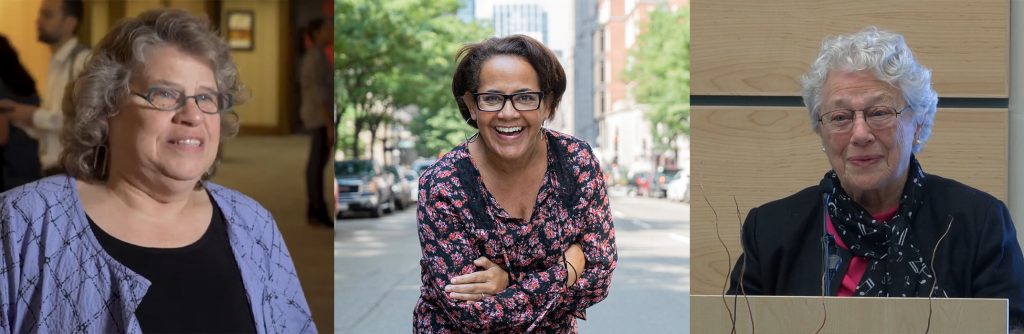
Lisa Simmons, Program Manager
Community arts leaders offer reflections as the LCC Program hits its 45th anniversary
To mark the end of the Local Cultural Council (LCC) Program’s 45th anniversary year, we went back to the beginning.
I spoke with Barbara Schaffer Bacon and Barbara Garvey — two leaders behind the creation of the LCC Program — to reflect on the program’s origins, evolution, and lasting impact on the Commonwealth.
 They helped establish the groundbreaking LCC model that put arts funding and decision-making directly into the hands of every city and town in Massachusetts.
It seems like from the beginning there was this sense of community — that everyone deserved funding and support.
Despite early challenges, which included failed lottery ticket sales, overwhelming paperwork, and tensions with the then state arts agency’s original focus on “excellence,” the program persevered because of community advocacy and incredibly dedicated volunteers.
What began as a grassroots push for fairness became a statewide commitment to cultural democracy.
Today, when a child dances in a school gym, when a storyteller visits a library, when a mural brightens a downtown corner, or when a community gathers for a festival, the legacy of those early advocates lives on.
The following transcript has been edited for clarity and length.
Lisa Simmons: So, Barbara Shaffer Bacon, welcome. What was your involvement in the Arts Lottery Program?
Barbara Schaffer Bacon: So, I was working at the Arts Extension Service, founded by [former Senate President] Stan Rosenberg, starting in 1977, and was working on getting arts councils started, especially in western Massachusetts. But, in general, we were trying to move the idea that local folks could get together and make the arts happen in their community, the arts that they wanted. But my whole career has been focused on local arts, local arts agencies, local arts councils.
Lisa Simmons: Great. And Barbara Garvey, welcome. Can you just tell us a little bit about you and your involvement in the Arts Lottery Program, now the Local Cultural Council Program?
Barbara Garvey: Well, I’d love to hear more from Barbara about the history of Arts Extension’s involvement, because I think that was an important factor in the success of these local councils — the work Arts Extension had done to foster local arts groups to be a part of a bigger part of arts funding across the state when the funding for the first arts lottery councils was established.
Now, Jackie O’Reilly was the person who really obtained the support of the Speaker of the House back then. She parlayed that into the local Arts Lottery Council’s funding by at first, creating an arts lottery ticket in support for the arts lottery. And so, the $5 lottery ticket went on sale. It was a special ticket that had a piece of artwork as part of the ticket. However, that lottery did not succeed at all, and so was folded into the regular lottery tickets.
Barbara Schaffer Bacon: And Barbara, what was your role? How did you come to be connected to it?
Barbara Garvey: I was speaking to groups throughout the state in support of funding for the arts, because it really was endangered. We had to support or ask people to support that funding through their own local legislators. I was appointed to the Massachusetts Arts Lottery Council (MALC) as one of the first five members who were going to administer this Arts Lottery Program. So, we were in early — under Governor Edward King — the five of us.
When the Arts Lottery Program began I think it was very enthusiastically received. And the support we got from the people on the staff was important because we were inundated with proposals.
I can remember being just stunned at how many applications we got. How were we going to process them? It was a very difficult position to be in.
Lisa Simmons: This is all pretty innovative at the time, right? To propose an arts lottery and to get it? And to know that it didn’t work at first must have spurred something in both of you, like, this is gonna work, and then getting the legislature involved? I mean, we are the only state — still — in the entire country that has a Local Cultural Council in every single city and town.
That’s amazing. And whatever work you all did to get that in place — that structure, the people, and the partners that you had to bring in — must have been an incredible feat.
Barbara Garvey: I have to give a lot of credit to Jackie O’Reilly and her contacts with the legislature, because she was able to foster interest in local arts and the people who wanted to have support for artists in their city or town.
She was able to make that into an organization. Then local people could actually make their work and get money from the state. So the systems that developed were built on the fostering that she had done through people that she knew, arts aficionados and so on, as well as people in the in the state senate who are going to follow.
Barbara Schaffer Bacon: Jackie was working for the folks who were not arts aficionados. The story that she always told was that she didn’t see why the dance school that her daughter might attend in her community couldn’t get funding from the Massachusetts Council on the Arts (MCA) and right — which it was called then — and she really went to the MCA and said, you know, there’s a lot happening in communities, and it should be supported, but the MCA at that time had an older concept of excellence that was tied to the fine arts and high achievement, and they really did not see it as their job to support community arts practices or artists in every community. It was not the same council that we have today, and it was in reaction to the MCA that they set up a separate program and a separate way for communities to get state resources.
So I feel like the second innovation, besides being in every city and town — that degree of decentralization — was the idea that the municipality, no matter how small, should acknowledge and have an arts council in their community that had appointed members, that community members could volunteer to serve on and have that base and an account, in the town records, literally to move the money. So really basing it within town government, I think, was the second and important thing.
Lisa Simmons: So, you have the MCA that was giving out excellence grants to all of a sudden also having MALC with its 351 cities and towns that now have their own Local Cultural Councils. In the beginning of the program, was local autonomy as big a part of the program as it is now?
Barbara Schaffer Bacon: So, there were some domestic arts and some other disciplines… those applications did raise some questions… it created a process where the local councils reviewed all of their applications, made their decisions. Those decisions were then moved on to the state staff, and MALC reviewed them, and then grant recommendations were finalized. So every single application… It wasn’t the kind of trust-based philanthropy. Everyone was worried about accountability. Right. And that accountability step, I think, accounted for a lot of the bureaucracy around the program.
Lisa Simmons: I’m curious as to how communities influenced the LCC Program design. Did they have a say in the design as it grew over the years? I’d love to talk a little bit about that volunteer involvement, and how that was structured.
Barbara Garvey: When Governor Dukakis took over there was now the feeling of… unity, of bringing the local arts and the local arts’ wishes and desires and hopes into the organization that was MALC… to the MCA. My recollection was that I resigned as board member of MALC and became manager of the Arts Lottery Program. So, for the next, I don’t know, year and a half, whatever it was, I worked both to streamline and improve the way that arts lottery councils would be able to get their wishes known, and then to create a piece of legislation that brought the two entities together.
Lisa Simmons: Can you talk a little bit about how that happened? How the two entities (MALC and MCA) came together to become the Mass Cultural Council (MCC)?
Barbara Schaffer Bacon: Mass Cultural Council changed its name at some point, and that’s when arts lottery councils became known as Local Cultural Councils.
When the Arts Lottery Program moved into the state arts agency, two things were created at Arts Extension Service, a guide for municipalities to actually tell them exactly how to operate the grant program — it was really intended for the municipal officials, so that there was clarity about how the money moved, how to make member appointments, and so on — sort of a technical guide.
And the second thing that the MALC did — through Arts Extension Service — was to hire a set of regional liaisons that operated not as staff members, but related to the state arts agency. These regional liaisons then were actually out in the communities meeting with the Local Cultural Councils, meeting with town officials, and really starting to be there to build the sort of operational effectiveness of those LCCs.
But in the earlier years, you know, members were getting appointed — because they were either speaking up or they were known in the community. And that also probably dictated how far out the outreach went to recruiting LCC members.
One mention I want to make — to go back in history — is that when the first lottery game that was special to the arts failed, what was then created was Megabucks. Originally the legislation was for all of the money from this special arts lottery to come to the arts. Obviously, Megabucks was so enormously successful that they capped the amount that would come to the arts from Megabucks.
It was intended to be a special stream of funding for the arts, which wouldn’t have been as reliant on budget decisions every year, and really, in that moment, we did lose that.
Lisa Simmons: What do you look back at? What are you proud of? You helped create this amazing program that is like no other, and it really does give those opportunities for cities and towns to make decisions, and for artists and creatives in those cities and towns to get funding to do cultural programming.
Barbara Garvey: Well, I was inspired, really, by many of the local arts lottery council’s programs, their funding a variety programs, and their grants to individual artists to produce whatever they had inside of themselves. That brought enormous satisfaction and pride to me.
One of the most joyous productions is a piece of sculpture, from… in a town, along, the highway, going south toward… from Massachusetts Turnpike to the Cape. This gorgeous sculpture of a young girl in her dress — her skirt is fluttering — doing a somersault. The sculpture will never leave my mind. It was so powerful, so joyous and so authentic.
That’s my greatest pride in being part of this effort: to support local artists.
Barbara Schaffer Bacon: I can’t top that story.
You know, I think that there is continuity in funding, in every city and town, and that you’re going to hear about the Local Cultural Council at least once when they are recruiting for applications and recruiting members AND you’re gonna hear about the LCC again when they announce their awards, and now our legislators help to kind of amplify that.
Then you’re going to hear about the funded projects as they’re happening. So the visibility of arts activity and arts happenings and the arts in every community has really expanded exponentially.
I do think that some of the creative economy and creative placemaking that we have seen blossom across the state really got a lot of its seeds sown and a lot of nurturing through the Arts Lottery Program and through the Local Cultural Councils now. I think that there are well over 30 communities now that invest in paying staff to make sure that their LCC is operating well in their communities and doing as much as they can, and many, many LCCs that do their own programming to fill the gaps that they see, or to get something else going. So we have some amazing volunteers.
To think that we have representatives like them in every community. I would love to see them convened more often, and really, feel that power of 329 or 351, because it’s really pretty amazing.
Lisa Simmons: What is your hope for today’s Local Cultural Council members? What do you want them to understand, not only about the roots of this program, but also about the incredible work that they’re doing in communities — and how they are basically, single-handedly bringing and supporting arts and culture in their communities?
Barbara Schaffer Bacon: I would just send a lot of acknowledgement and appreciation for folks having stepped up. Because you do, you have to put in time, you also have to really care about what’s happening and want to be responsive, and I see that. I see that in the information sessions that are offered, when people are out and about and say, “I’m from the LCC”, and so I know people are there,
I see our Local Cultural Council members as our activists and advocates, both.
I’m really interested in the whole idea of phenomenology as a way to study, and that an LCC receiving applications is seeing trends in their own community, and seeing where interests lay can use it as a data gathering method. Because of the LCC Program, it is becoming more and more natural within each community for folks to step up and say, “I want to be doing this. I see this space in my community that I want to see changed, and I’m gonna call on some information.”
I see more and more often folks within LCCs trying to help the artists and the other groups that are coming to them find other resources and make sure that other people know about that work. And I am so appreciative of that investment of time, interest, and support for the arts.
Lisa Simmons: Do you feel good about where we are today, based on all of the work that you both did to sort of get us to where we are, and those number of applications that have come in, and the arts and culture that are happening throughout the state because of that work that you all did?
Barbara Garvey: Oh, I’m so proud of what you’re doing, and proud of what we all have helped to create in the state of Massachusetts. It’s wonderful work that we can look back on with pride and satisfaction.
Barbara Schaffer Bacon: Very much so. My way of thinking about it, is that… in many, many communities, if you go in and you start talking with people and with elected officials and their staff members, they know names of staff people at the Mass Cultural Council. Somebody from Mass Cultural has been out in their community talking to them, has shown up at something.
I think that the Arts Lottery Program also changed the Mass Cultural Council considerably, and its visibility in local communities is not just exceptional, it’s exceptional within state agencies altogether. And I love it when I walk into a place and there’s somebody from some other state agency, and no one knows who they are, but everyone knows the person who’s there from Mass Cultural, because they’ve been there before.
I really like that community arts has become far more central to the role of the arts in the Commonwealth and I really appreciate you for that, And I just want to see more of it. I want to see that local power expanded even further. I do not want to see only regional arts councils.